Face Proportions Test
Upload one selfie. Our AI measures your facial fifths — the five horizontal zones of a balanced face — and scores how evenly your proportions divide in seconds.
Free · No sign-up · Your photo isn't stored
Face straight on, even lighting, neutral expression
How the face proportions test works
The analyzer measures five horizontal zones of the face and scores how evenly they divide — all from a single front-facing photo.
Map the horizontal landmarks
The AI locates your eye corners and the outer edges of your face — the six boundaries that define your five facial fifths.
Measure each fifth
Each fifth is expressed as a percentage of total face width. The classical ideal is five equal fifths — each at roughly 20%.
Score the proportions
A proportion score from 0 to 100 reflects how evenly your fifths divide. Plain-language notes describe what the AI observed.
What your proportion score means
Most faces don't divide into perfectly equal fifths. Here is how the scoring breaks down across the full range.
Well Proportioned
Classical ideal
All five fifths are very close to equal width — the classical standard. Genuinely uncommon in real faces.
Balanced
Most common
Most fifths are near the 20% ideal; one or two diverge mildly. This is where the vast majority of faces land.
Distinctively Proportioned
Normal variation
One or more zones diverge substantially. Wide-set or close-set eyes and asymmetric margins are all common and normal.
What are facial proportions?
Facial proportions describe how the features of the face relate to each other in size and spacing — how wide your eyes are relative to the width of your face, how much space sits between them, how much face extends beyond them on each side. While symmetry asks whether the left and right halves of your face mirror each other, proportion asks whether the features are scaled and spaced in a harmonious way.
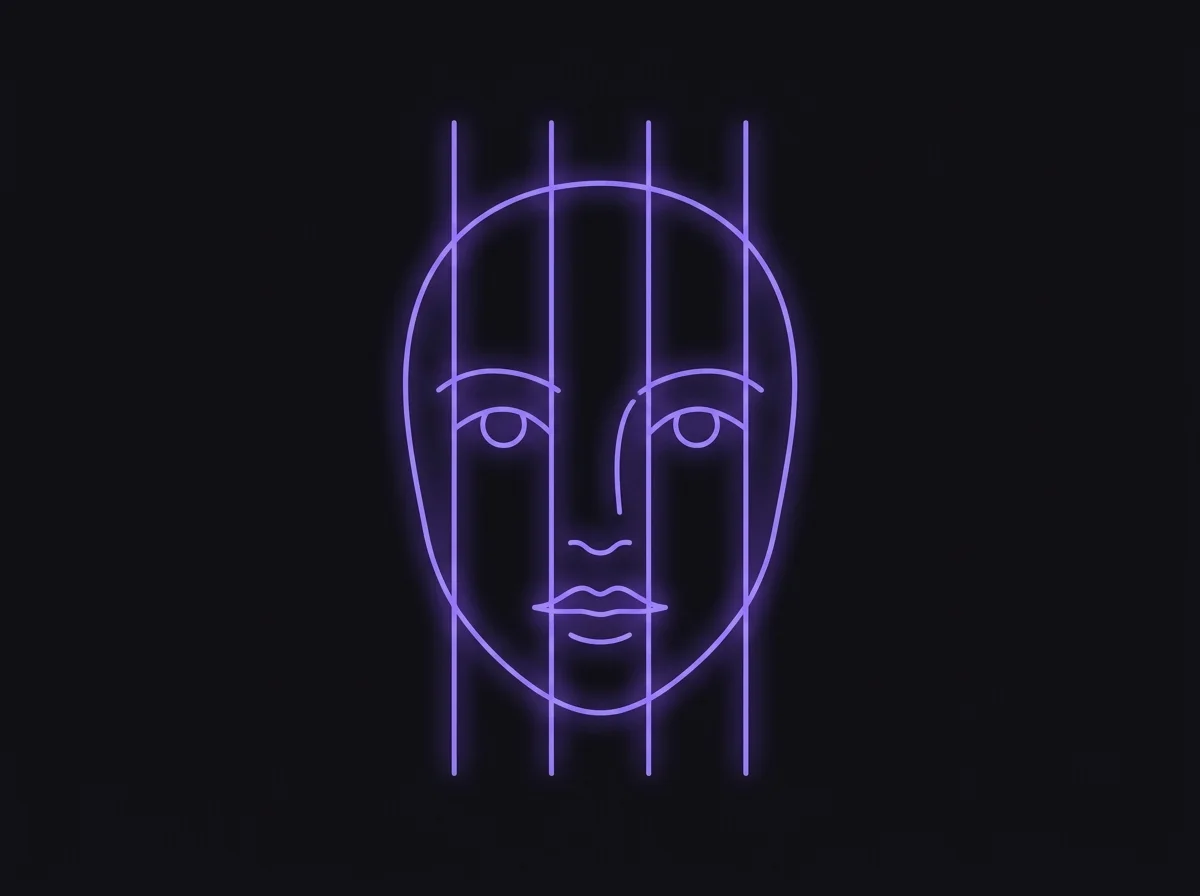
The most widely referenced framework for horizontal facial proportion is the facial fifths rule — the idea that a balanced face is approximately five eye-widths wide, so each of the five horizontal zones occupies about 20% of total face width. This system was codified in neoclassical anatomy and has been used in aesthetic medicine, surgical planning, and art instruction ever since. It is one of the oldest and most reproducible standards in facial aesthetics.
Crucially, very few real faces hit the ideal precisely. Wide-set and close-set eyes are common and regularly perceived as attractive. Broader or narrower outer margins simply reflect the width of the skull and cheekbones. The score quantifies where you sit relative to the classical benchmark — it is not a rating of appearance.
The facial fifths explained
Each of the five horizontal columns reflects a different structural zone of the face. Here is what a wide or narrow reading in each one typically indicates.
1st fifth
Outer left margin
The space from the outermost left edge of the face to the outer corner of the left eye. A wide 1st fifth means the face extends further beyond the left eye — influenced by skull width and cheekbone prominence.
2nd fifth
Left eye width
The horizontal width of the left eye from outer to inner corner. This is the reference unit for the whole framework: ideally each fifth equals one eye-width. Larger eyes naturally make this fifth wider.
3rd fifth
Inter-eye gap
The space between the inner corners of both eyes. Ideally equals one eye-width (~20%). A wider gap means wide-set eyes; a narrower gap means close-set eyes. Both are common across all ethnicities.
4th fifth
Right eye width
The horizontal width of the right eye. Ideally matches the 2nd fifth (left eye width). A significant mismatch here may indicate slight asymmetry in eye size or subtle head rotation in the photo.
5th fifth
Outer right margin
The space from the outer corner of the right eye to the outermost right edge of the face. Should ideally match the 1st fifth. When these two outer margins differ, the face reads as slightly off-center.
Facial thirds vs fifths vs golden ratio
These three proportion frameworks are frequently conflated, but they measure genuinely different things. No single number captures the full picture of facial balance.
Facial fifths
The horizontal proportion framework — how the face divides into five side-by-side columns across its width. This is what this tool scores.
Facial thirds
The vertical proportion framework — how the face divides into upper (hairline to brow), middle (brow to nose), and lower (nose to chin) zones by height. A separate axis entirely. Check yours at our Facial Thirds Test. Facial Thirds Test.
Facial symmetry
How closely the left and right halves of your face mirror each other across the vertical midline. Measures correspondence, not proportion. Check yours at our Face Symmetry Test. Face Symmetry Test.
Golden ratio
Whether specific distances between features approximate the ratio 1:1.618 (phi). Widely cited in aesthetic contexts; research on whether it reliably predicts perceived attractiveness is mixed. Check yours at our Golden Ratio Face test. Golden Ratio Face.
The Symmetry IQ app measures facial proportions, left-right symmetry, the golden ratio, and five other metrics in one scan — so you get a complete, multi-dimensional picture rather than one number.
What makes facial proportions look off?
Some causes are structural and fixed; others are transient, habitual, or simply a reflection of how the photo was taken.
Eye spacing (wide-set or close-set)
The inter-eye gap is the single biggest driver of proportion score variation. Wide-set eyes increase the 3rd fifth and compress the outer margins; close-set eyes do the opposite. Both are common and neither signals a problem.
Face width and skull shape
A wider face with prominent cheekbones increases the outer fifths (1st and 5th). A narrow face compresses them. This is determined almost entirely by bone structure and genetics.
Eye size difference
If the eyes differ noticeably in horizontal width, the 2nd and 4th fifths won't match. This often reflects mild anatomical asymmetry or subtle head rotation in the photo rather than a true size difference.
Head rotation in the photo
Even a small horizontal turn compresses the near eye and expands the far one, distorting the fifths. A straight-on shot at eye level gives the most accurate reading.
Brow and temple width
The outer edge of the face is typically measured at the temples. Wider temples push the outer margins outward and raise the outer-fifth readings.
Aging and soft-tissue change
Temporal hollowing with age can narrow the apparent outer face width, subtly shifting all five fifths. Underlying bone proportions stay fixed, but the soft-tissue silhouette changes over time.
Track all 8 facial metrics in one place
This tool scores your horizontal facial proportions from one photo. The Symmetry IQ app measures facial proportions alongside left-right symmetry, the golden ratio, jaw definition, and four more metrics — and builds a personalized daily routine to help you improve.

Face proportions — FAQ
What are facial fifths and why do they matter?
The facial fifths framework divides the face into five equal horizontal columns, each roughly the width of one eye. From left to right: the outer left margin, the left eye, the inter-eye gap (which ideally equals one eye-width), the right eye, and the outer right margin. When each fifth is close to 20% of total face width, the face is considered horizontally proportionate by the classical standard. It is a widely referenced framework in facial aesthetics, anatomy teaching, and aesthetic medicine — offering a horizontal complement to the vertical facial-thirds rule.
How does the face proportions test work?
Upload a front-facing photo. The AI identifies your eye corners, the outer edges of your face, and the boundaries of each horizontal zone. It estimates each fifth as a percentage of total face width, checks how evenly they divide, and computes a proportion score from 0 to 100. Higher scores mean each fifth is closer to the equal-20% ideal.
What is a good facial proportion score?
A score of 82 or above means your fifths are very close to equal — the classical ideal. Scores of 65-81 are the most common range, where one or two fifths diverge mildly. Below 65 means one zone differs substantially, which is normal variation — wide-set or close-set eyes, for instance, are extremely common and widely perceived as attractive features in their own right.
Is the test free and private?
Yes. The test is completely free with no sign-up required. Your photo is sent securely for a single analysis and is not stored, shared, or used to train models.
What does it mean to have wide-set or close-set eyes?
Wide-set eyes mean the inter-eye gap (3rd fifth) is larger than one eye-width, pushing the outer margins narrower. Close-set eyes mean the inter-eye gap is smaller than one eye-width, making the eyes appear closer to the bridge of the nose. Both are common, both appear regularly in people considered attractive, and neither is a flaw — they are simply descriptions of where your proportions sit relative to the equal-fifths ideal.
How is the facial fifths test different from facial thirds?
They measure different axes. Facial thirds measures the vertical axis — how your face divides into upper (hairline to brow), middle (brow to nose base), and lower (nose to chin) horizontal zones. Facial fifths measures the horizontal axis — how your face divides into five side-by-side columns across the width of your face. A face can have balanced thirds but uneven fifths, or vice versa. Together they give a more complete picture of facial proportion. You can test your facial thirds at our Facial Thirds Test.
Does camera angle affect the proportion reading?
Yes. The most accurate reading comes from a straight-on photo with the camera at eye level, even lighting, and a relaxed expression. Turning the head to one side compresses one eye and its margins, making proportions appear skewed. If the photo is too angled or a key landmark is obscured, the tool will ask you to retake it.