Why Does My Face Look Asymmetrical in Photos?
Your face looks more asymmetrical in photos mostly because you're used to your mirror image, phone cameras distort faces at close range, and a still photo exaggerates small tilts and uneven light. Some of what you see is real; a lot of it is the camera.
TL;DR
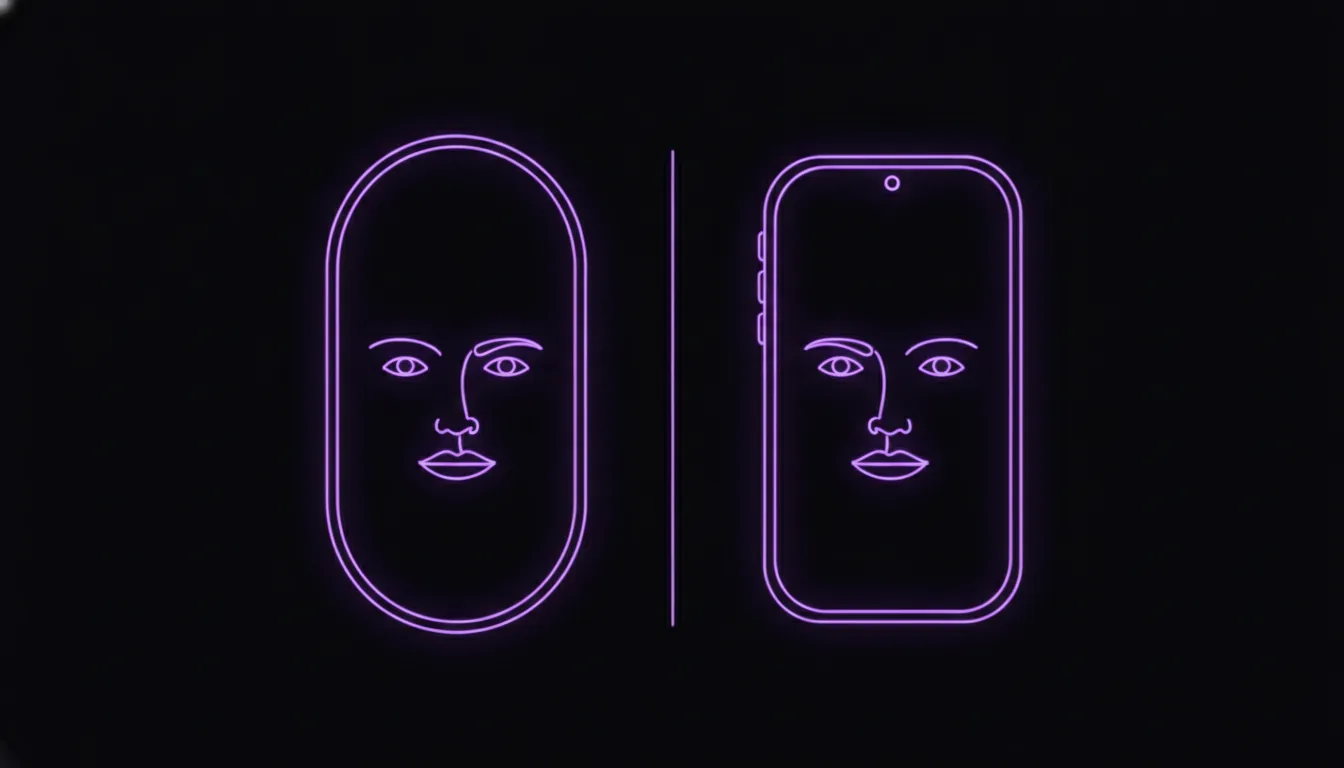
Two effects stack in a selfie. You prefer your mirror image because it's the one you see most (Mita, Dermer & Knight, 1977), so the unflipped photo feels off. And at about 12 inches a phone makes your nose look around 30% wider than it does from five feet away (JAMA Facial Plastic Surgery, 2018), which magnifies whichever side is closer. Take photos from further away, level and evenly lit, before deciding your face is uneven.
Why you look different in photos than in the mirror
You look different in photos because the mirror flips your face and the camera doesn't. Every face is a little uneven, so the flipped and unflipped versions really are different images. You've learned your face through the flipped one.
Psychologists tested this in 1977 by showing people two prints of their own face, one normal and one mirror-reversed. People preferred the mirror version of themselves, while their close friends preferred the true photo, each picking the version they saw most often (Mita, Dermer & Knight, Journal of Personality and Social Psychology). That's why a photo of you can look lopsided to you and completely normal to everyone else.
6 reasons your face looks uneven in pictures
Most of these are about the photo, not your face.
1 · You're used to your mirror image
You've seen your face flipped in mirrors thousands of times, so that version feels right. Photos show the unflipped face, where your slightly higher brow or fuller cheek appears on the other side. Your brain flags it as wrong even though nothing changed.
2 · The phone is too close
Selfies are taken at around arm's length, and at that distance the parts of your face nearest the lens are magnified. Turn your head a few degrees and one cheek, eye or side of the jaw gets bigger than the other.
3 · A small head tilt or turn
A tilt you'd never notice in person moves one eye higher and one jaw corner lower in a still photo. Most people have a habitual tilt, and it shows up in nearly every picture.
4 · Light from one side
Side lighting puts one half of your face in shadow, which makes that side look narrower, flatter or more hollow. A window or lamp off to one side is enough.
5 · Wide-angle lens stretch
Phone cameras use wide-angle lenses, which stretch whatever sits near the edges of the frame. If your face is off-centre, one side gets pulled wider than the other.
6 · Expressions are uneven
Most smiles lift one side of the mouth more than the other, and one eye often closes more when you laugh. A photo freezes the most uneven moment of an expression that looks balanced in motion.
Front camera vs back camera: which one is accurate?
The back camera, used from a few feet away, is the more accurate of the two. The front camera has two problems. You hold it at arm's length, which is close enough to distort your face, and many phones show you a mirrored preview but can save the unflipped photo, so the picture you get doesn't match the face you were just looking at.
On iPhone you can choose whether front-camera photos are saved mirrored with the Mirror Front Camera switch in the Camera settings, and many Android phones have a similar option. That changes which way the photo is flipped, not the close-range distortion.
The back camera shows your face unflipped, the way other people see it, and because you can't easily watch yourself while shooting, you tend to hold a more natural expression. Put it at eye level, step back, and zoom in a little.
How much a close-up camera distorts your face
A close-up camera distorts your face a lot more than most people expect. Researchers at Rutgers modelled photos taken at about 12 inches, a typical selfie distance, against photos from much further away. The close shots made the nose look around 30% wider at its base and the tip about 7% wider (Ward et al., JAMA Facial Plastic Surgery).
The same thing happens to the rest of your face. Whatever is closer to the lens grows, so a head turned even slightly toward one side makes that cheek, eye and jaw corner look bigger. That's why one side can look noticeably bigger in a selfie and much less so in a photo someone else takes from across a room.
How to take an accurate photo of your face
This is the setup to use before you judge your symmetry, and the one to repeat every time you want to compare.
- 1Use the back camera, not the front one, so you're seeing the unflipped image without a mirrored preview.
- 2Stand about 5 feet (1.5 m) from the camera and zoom in about 2x instead of moving closer.
- 3Put the camera at eye level, on a shelf or tripod, and use the timer.
- 4Face a window or soft light straight on so both sides of your face are lit the same.
- 5Level your head: chin neither raised nor tucked, ears at the same height, eyes looking into the lens.
- 6Keep a relaxed, neutral expression with lips gently closed.
- 7Take three photos a few seconds apart and compare them, not just one.
What if the asymmetry is still there?
If the same difference shows up in three well-taken photos, it's real, and that's normal: no face is perfectly symmetrical. The next step is working out where it comes from. A wider jaw corner on one side usually points at the chewing muscle, covered in why one side of your face is bigger. A difference that's worse in the morning points at your sleep position. Eyes that sit at different heights have their own guide in uneven eyes.
For a number instead of a judgment call, run the free Face Symmetry Test on a photo taken with the setup above. It scores how closely your two halves match and shows which regions (eyes, brows, cheeks, jaw or smile) differ most. The Symmetrical Face Mirror shows what your face looks like built from two left halves or two right halves, which makes the difference easy to see.
The Symmetry IQ app uses the same kind of scan, scores 8 facial-symmetry measurements, and keeps your history, so you can compare like with like instead of selfie with selfie.
Is it your face or your camera?
Take one level photo from a few feet away and get a 0-100 symmetry score with a breakdown by region. The Symmetry IQ app then tracks it scan over scan, in the same conditions every time.

Asymmetrical in photos: frequently asked questions
Why does my face look asymmetrical in photos but not in the mirror?
A mirror shows you a flipped version of your face, and that flipped version is the one you've learned to see as 'you'. A photo shows the unflipped face, so every small difference lands on the opposite side from where you expect it and suddenly looks wrong.
Is the front camera or the back camera more accurate?
The back camera, used from a few feet away with a little zoom, is closer to how people see you. The front camera is usually held too close, which distorts the face, and many phones show a mirrored preview, so you're comparing two different versions of yourself.
Why do I look asymmetrical in the back camera?
Because it shows your face unflipped, the way other people see it, and you're used to the mirror. If the back camera is also close and below eye level, it adds distortion on top. Try it at arm's length or further, at eye level, before deciding anything.
Do other people see my face the way photos show it?
They see the unflipped version, like a well-taken photo, but they see it moving, in three dimensions, from a normal distance. Small asymmetries that jump out at you in a still photo are far less noticeable in person.
Why does one side of my face look bigger in selfies?
At selfie distance, whatever is closest to the lens grows. Turn your head even slightly and the nearer cheek reads bigger. Hold the phone level and further away and most of that difference shrinks.
How do I know if my face is really asymmetrical?
Take three photos from about five feet away with the camera at eye level, head level, neutral expression and even light. If the same difference shows up in all three, it's real. If it moves around between photos, it was the camera, the angle or the light.