Facial Thirds Test
Upload one selfie. Our AI measures your upper, middle, and lower facial thirds and scores how evenly they divide — the classical neoclassical proportion standard.
Free · No sign-up · Your photo isn't stored
Face straight on · hair off your forehead · even lighting
How the facial thirds test works
The analyzer measures three horizontal zones of the face and scores how evenly they divide — all from a single front-facing photo.
Find the dividing lines
The AI locates your hairline, brow line, the base of your nose, and your chin — the four boundaries that define your three facial thirds.
Measure each zone
Each third is expressed as a percentage of total face height. The classical ideal is three equal thirds — each at roughly 33%.
Score the balance
A balance score from 0 to 100 reflects how closely your thirds match equal division. Plain-language notes describe what the analyzer observed.
What your balance score means
Most faces are not divided into perfectly equal thirds. Here is how the scoring breaks down across the full range.
Balanced
Classical ideal
All three thirds are very close in height — within roughly 2% of each other. This is the neoclassical canon and genuinely uncommon in real faces.
Slightly Uneven
Most common
One third is mildly longer or shorter than the others. This is where the vast majority of faces land — it is the statistical norm.
Distinctively Proportioned
Normal variation
One zone diverges substantially. A long lower third is typical in men; a tall forehead is common across all face shapes. Neither is a flaw.
What are facial thirds?
Facial thirds is a system for describing face height proportions. The face is divided into three horizontal zones by four landmarks: the hairline, the brow line, the base of the nose, and the bottom of the chin. In the classical canon — formalized by Renaissance anatomists and later by neoclassical artists — the aesthetically balanced face has all three zones at approximately equal height.
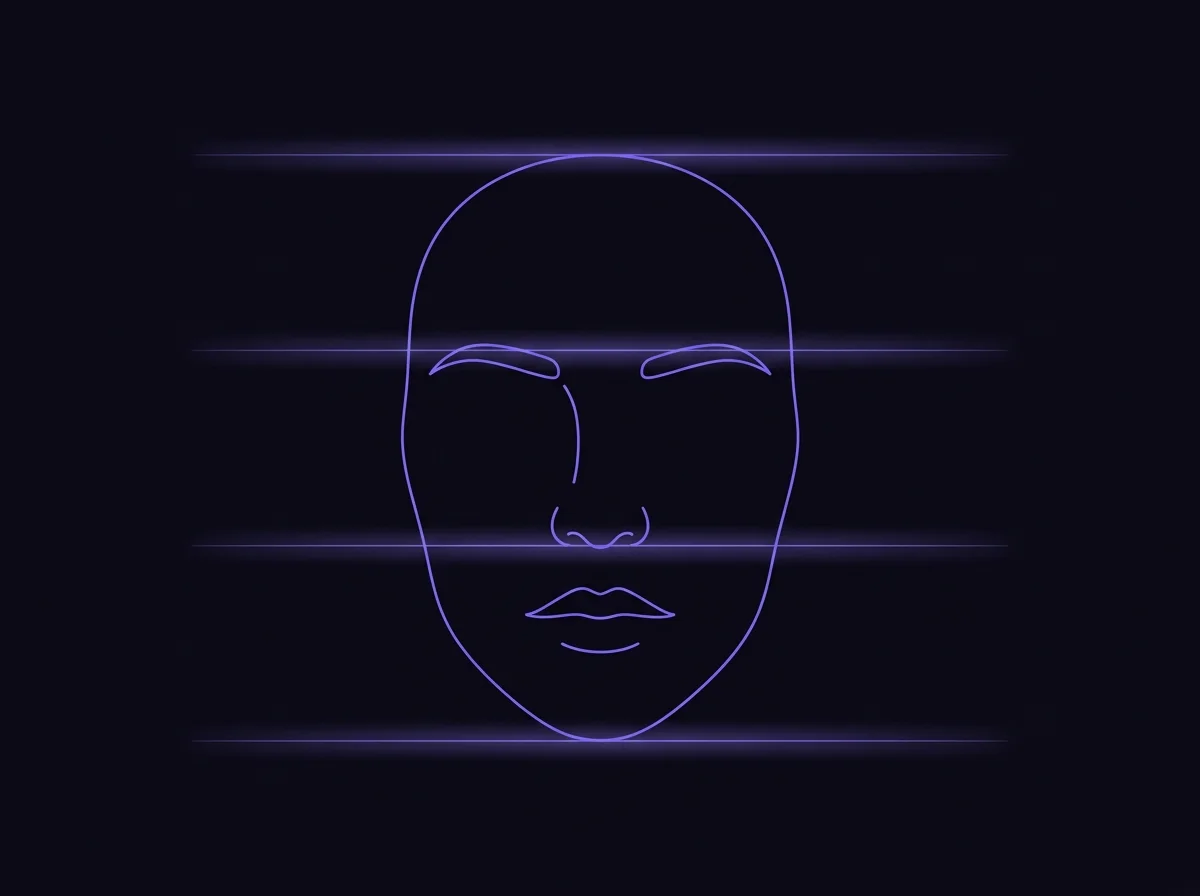
The idea dates at least to Leonardo da Vinci, who documented it in his anatomical notebooks in the 1480s, and was later popularized in medical and surgical literature as a reference for facial proportion. It appears regularly in aesthetic medicine and orthodontics as a framework for describing how face height is distributed.
Critically, equal thirds is a classical reference, not a universal law. Real human faces vary enormously, and a face with unequal thirds is not in any way deficient — it is simply described differently against the canon. A long lower third is statistically more common in men; a tall upper third is common in many ethnicities. The tool scores balance relative to the equal ideal so you have objective data, not because deviation signals a problem.
What each third tells you
Each zone reflects a different structural region of the face. Here is what a long or short reading in each one typically means.
Upper third
Hairline to brow
If longer
A long upper third means a high forehead — common in men with a receding hairline, and in many people generally. Contributes to a more elongated face shape.
If shorter
A short upper third means the forehead is compact. More common in women and in faces with lower hairlines.
Middle third
Brow to nose base
If longer
A long middle third means the midface — from brow to nose tip — takes up more vertical space. Associated with a prominent nose bridge or strong brow ridge.
If shorter
A short middle third gives the impression of a flat or concave midface profile when viewed from the side, and is common in certain facial structures.
Lower third
Nose base to chin
If longer
A long lower third is the most common deviation from equal thirds, particularly in men. It means the lower face — jaw and chin height — is more dominant. Often reads as a strong jaw.
If shorter
A short lower third means a smaller chin-to-nose distance. Common in retrognathic profiles (the chin sits further back) or in faces with a higher nose-to-lip ratio.
What makes facial thirds uneven?
Some causes are structural and fixed; others vary with age, habits, or simply how the photo was taken.
Hairline height and recession
The upper third is measured to the hairline. A naturally high hairline or a receding one extends the upper third, pulling the balance score down even though the underlying bone structure is unchanged.
Forehead size
Forehead height is largely determined by skull shape and genetics. A large forehead is one of the most common reasons for an unequal upper third.
Lower-face length
Chin and jaw height are skeletal. A longer lower face — more vertical chin height — is especially common in men and in certain skeletal growth patterns.
Camera angle and chin tilt
Tilting the chin up shortens the apparent lower third; tilting it down lengthens it. A straight-on shot with a level chin gives the most accurate measurement.
Age-related changes
Soft-tissue descent and volume loss with age can shift how the midface reads. The underlying bony thirds stay fixed, but the soft-tissue impression changes.
Hair obscuring the hairline
Bangs or hair covering the forehead make the upper third boundary ambiguous. For the most accurate reading, pull hair back to expose the full hairline.
Facial thirds vs symmetry vs golden ratio
These three frameworks are frequently conflated, but they measure different things. No single number captures the full picture.
Facial thirds
How evenly the face divides into upper, middle, and lower vertical zones. This is what this tool scores — a top-to-bottom proportion check.
Facial symmetry
How closely the left and right halves of your face mirror each other across the vertical midline — eyes, brows, cheeks, jaw. Entirely separate from thirds. Test yours at our Face Symmetry Test. Face Symmetry Test.
Golden ratio
Whether specific distances between facial features approximate the ratio 1:1.618. It is often cited in aesthetic contexts, but research on whether it actually predicts perceived attractiveness is mixed.
The Symmetry IQ app measures facial thirds, left-right symmetry, and six other metrics in one scan — so you get a complete, multi-dimensional picture rather than a single number.
Track all 8 facial metrics in one place
This tool scores your facial thirds balance from one photo. The Symmetry IQ app measures facial thirds alongside left-right symmetry, the golden ratio, jaw definition, and four more metrics — and builds a personalized daily routine to help you improve.

Facial thirds — FAQ
What are facial thirds and why do they matter?
Facial thirds divide the face into three roughly equal horizontal zones: the upper third (hairline to brow), the middle third (brow to the base of the nose), and the lower third (base of the nose to the chin). The neoclassical canon — formalized by Renaissance artists and later by medical anatomists — holds that faces perceived as proportionate tend to have all three zones at similar heights. This tool measures how close your face comes to that equal-thirds benchmark.
How does the facial thirds analyzer work?
Upload a front-facing photo. The AI identifies your hairline, brow line, the base of your nose, and your chin, then estimates the height of each zone as a percentage of total face height. A balance score (0-100) reflects how evenly the three thirds divide: 100 means all three are within roughly 2% of each other; the score falls as they diverge.
What is a good facial thirds balance score?
A score of 82 or above means your thirds are very close to equal — the classical ideal, and genuinely uncommon. Scores of 65-81 are the most common range, indicating one third is mildly longer or shorter. Below 65 means one third diverges substantially, which is normal variation — a long lower third is typical in men, and a tall forehead is extremely common across all face shapes.
Is the test free and private?
Yes. The test is completely free with no sign-up required. Your photo is sent securely for a single analysis and is not stored, shared, or used to train models.
Can I still have balanced thirds if I have a high forehead or long jaw?
Yes. A 'high forehead' means your upper third is longer than the other two, which will lower the balance score — but the score just describes the proportion, not whether your face looks good. Faces with unequal thirds are common, familiar, and often read as striking or interesting. Balance score is one piece of data, not a verdict on appearance.
How is facial thirds different from facial symmetry?
They measure different things. Facial symmetry scores how closely the left and right halves of your face mirror each other. Facial thirds scores how evenly your face divides into upper, middle, and lower zones. A face can be highly symmetric but have unequal thirds, or have perfectly equal thirds but significant left-right asymmetry. The Symmetry IQ app measures both, along with six other facial metrics.
Does camera angle affect the result?
Yes. For the most accurate reading, face the camera straight on with even lighting, a relaxed expression, and hair off your forehead so the hairline is visible. Tilting your chin up or down changes the apparent height of each zone. If the photo is too angled or your hairline or chin is obscured, the tool will ask you to retake it.
Keep exploring