Face Symmetry Test
Upload one selfie. Our AI scores how closely the left and right halves of your face mirror each other — eyes, brows, jaw and smile — in seconds.
Free · No sign-up · Your photo isn't stored
Face straight on, even lighting, neutral expression
How the symmetry test works
Facial symmetry is how closely the two halves of your face mirror each other. Here's what the analyzer measures from a single photo.
Find the midline
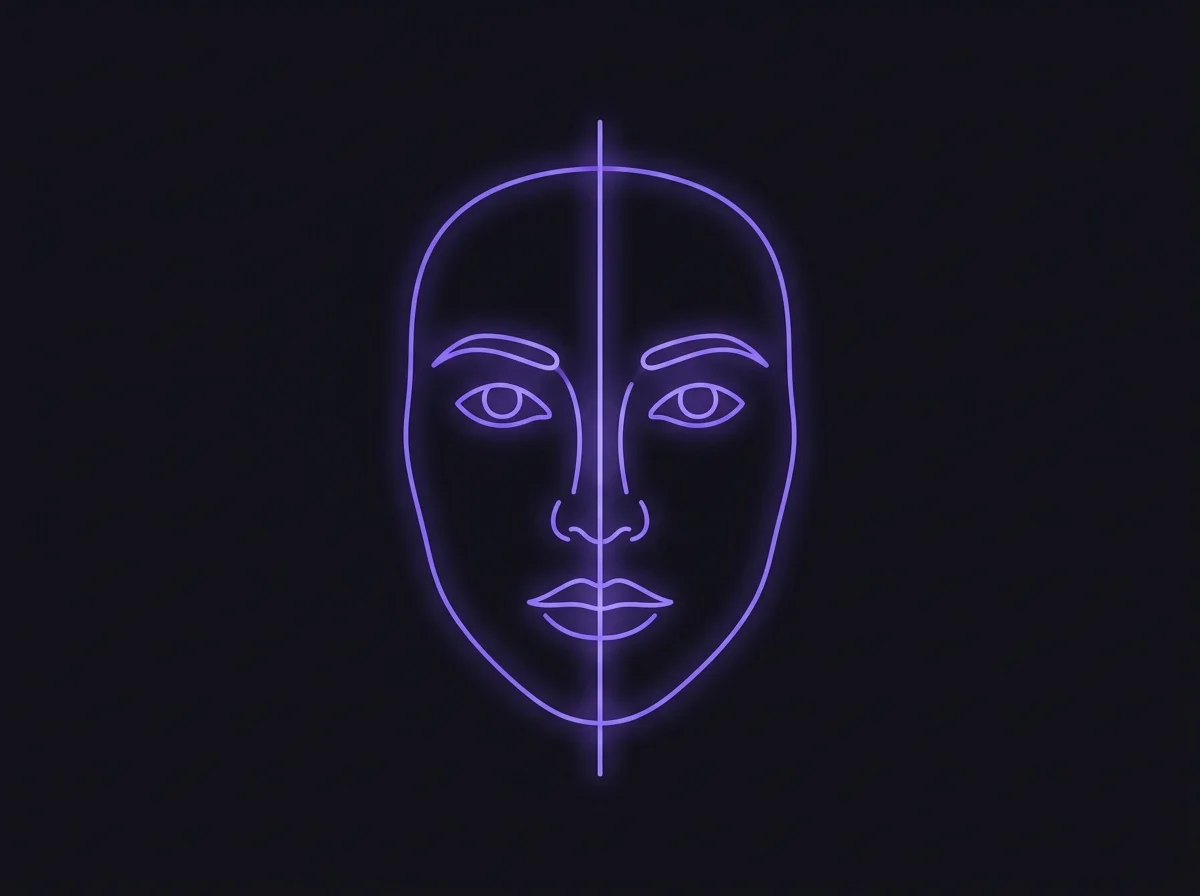
The AI maps your facial landmarks and the vertical midline that splits your face into left and right halves.
Mirror and compare
It compares each side against the other across your eyes, eyebrows, cheekbones, jaw and smile.
Score every region
Each region gets a correspondence score, combined into one symmetry score from 0 to 100 with plain-language notes.
What your symmetry score means
Every face is asymmetric to some degree — perfect symmetry doesn't exist in nature. Here's how the score breaks down.
Highly Symmetric
~10% of faces
Both halves mirror each other tightly across nearly every region. Genuinely uncommon — most people sit lower than they expect.
Well Balanced
Most common
Strong side-to-side correspondence with one or two regions diverging mildly. The majority of faces land here.
Naturally Distinctive
Normal variation
Several regions differ noticeably between sides. This is normal human variation and is often invisible to other people.
What is facial symmetry?
Facial symmetry is how closely the left and right halves of your face mirror each other when split down the vertical midline. A highly symmetric face has eyes at the same height, brows with matching arches, cheekbones with equal projection, and a jaw that carries the same definition on both sides.
Symmetry is one of the most studied signals in facial aesthetics because it's thought to reflect developmental stability — how evenly the face grew. That's why it shows up again and again in research on what people perceive as balanced or attractive. But it is only one piece of the picture: proportion and averageness matter too, which is why a face can be slightly asymmetric and still read as harmonious.
Crucially, no one is perfectly symmetric. Hold a mirror to the center of any face and you'll create two slightly different people. Mild asymmetry is the norm, it's usually imperceptible to others, and it's part of what makes a face look human rather than digitally generated.
What the test measures
The analyzer compares your two sides across five regions, then combines them into one score.
Eyes
Whether your eyes sit level with each other, and match in size and openness. A high or hooded eye on one side is the most commonly noticed asymmetry.
Eyebrows
Height and arch of each brow. Brows are highly mobile, so a habitual raise on one side can show up here.
Cheekbones / midface
Fullness and projection of each cheek. Sleeping on one side and uneven fat distribution both play in.
Jaw & chin
Whether both sides of the jaw carry the same angle and definition, and whether the chin sits on the midline.
Mouth / smile
Corner height and lip balance. A smile that pulls higher on one side is extremely common and usually muscular, not structural.
What causes facial asymmetry?
Some drivers are fixed, but many are habits and posture that shift over time — which is the part worth tracking.
Sleep position
Always sleeping on one side puts sustained pressure on that half of the face and jaw.
Chewing one-sided
Favoring one side to chew builds the masseter unevenly, subtly widening that side of the jaw.
Posture & neck tilt
Forward head posture and a habitual head tilt rotate the face away from a true front view.
Muscle habits
Always raising one brow or smirking to one side trains the muscles into a resting imbalance.
Sleep & puffiness
Salt, alcohol and poor sleep cause uneven fluid retention that reads as day-to-day asymmetry.
Structure & genetics
Some bone and dental asymmetry is built in and fixed — but it's usually a small part of the total.
Symmetry isn't the same as proportion
People mix up three different ideas. Knowing the difference is why one tool can't tell you everything:
Symmetry
How well your left and right sides mirror each other. That's what this test scores.
Proportion
How your features relate in size and spacing — facial thirds, the golden ratio, eye spacing. A perfectly symmetric face can still have unbalanced proportions.
Averageness
How close your features sit to the population average. Research finds averageness and symmetry both contribute to perceived harmony, independently.
The Symmetry IQ app scores all of these together across 8 metrics — so you get the full picture, not just one number.
Track your symmetry over time
This test is a one-time snapshot. The Symmetry IQ app scores 8 facial-symmetry metrics, tracks your progress, and builds a personalized daily routine so you can see whether your balance is improving.

Face symmetry test — FAQ
How does the face symmetry test work?
Upload a single front-facing photo. Our AI locates your facial landmarks, establishes the vertical midline of your face, and compares the left half against the right across your eyes, eyebrows, cheekbones, jaw and smile. Each region is scored for how closely the two sides mirror each other, and the results are combined into one symmetry score from 0 to 100.
Is my face symmetrical? What is a good symmetry score?
No face is perfectly symmetrical — perfect symmetry does not exist in nature. A score of 85+ is highly symmetric and uncommon, 65–84 is well balanced and where most faces land, and below 65 means your features are naturally more distinctive from side to side. None of these are 'bad'; mild asymmetry is normal and often imperceptible to others.
Is the face symmetry test free and private?
Yes. The test is completely free with no sign-up. Your photo is sent securely for a single analysis and is not stored or used to train models. Everything runs from one selfie.
Will tilting my head affect the result?
For the most accurate score, face the camera straight on with even lighting and a neutral expression. The analyzer corrects for small tilts, but a heavy head turn or strong shadow can be read as asymmetry. If a photo is too angled or obscured, the tool will ask you to retake it.
Can I actually improve my facial symmetry?
Some drivers of perceived asymmetry — posture, sleep position, chewing on one side, uneven facial-muscle tone, skin and puffiness — respond to consistent habits over time. The Symmetry IQ app tracks your symmetry score and builds a personalized daily routine so you can see whether it moves. Structural bone asymmetry is fixed, but how balanced your face looks day to day is not entirely.