Golden Ratio Face Calculator
Upload one selfie. Our AI measures how closely your facial proportions follow the golden ratio (phi ≈ 1.618) across three classical measurements — in seconds.
Free · No sign-up · Your photo isn't stored
Face straight on, even lighting, neutral expression
How the golden ratio analysis works
Phi (φ ≈ 1.618) is a proportion. The tool measures whether key distances on your face follow that ratio.
Find the landmarks
The AI locates key facial anchor points — hairline, chin, corners of the eyes, nose tip, and corners of the mouth.
Measure the phi ratios
Three classical proportions are estimated: face length-to-width, mouth-to-nose width, and lower-face thirds. Each is compared to the 1.618 ideal.
Score phi adherence
The closeness of each measured ratio to phi is averaged into a composite phi score from 0 to 100, with a plain-language verdict.
What your phi score means
The vast majority of human faces diverge from the phi ideal in at least some measurements. Here's how the tiers break down.
Golden
~10–15% of faces
Phi adherence is notably strong across most measurements. Genuinely uncommon — most people score lower than they expect.
Harmonious
Most common
Proportions approximate phi reasonably well, with some measurements closer than others. This is where most aesthetically balanced faces land.
Distinctive
Normal variation
Ratios diverge from the 1.618 ideal across several measurements. This is the most common outcome — the phi standard is a specific classical ideal, not a universal norm.
What is the golden ratio?
The golden ratio — represented by the Greek letter phi (φ) and approximately equal to 1.618 — is a mathematical proportion that has captured human attention for thousands of years. It describes a relationship where the ratio of a larger quantity to a smaller one equals the ratio of their sum to the larger: (a + b) / a = a / b = phi.
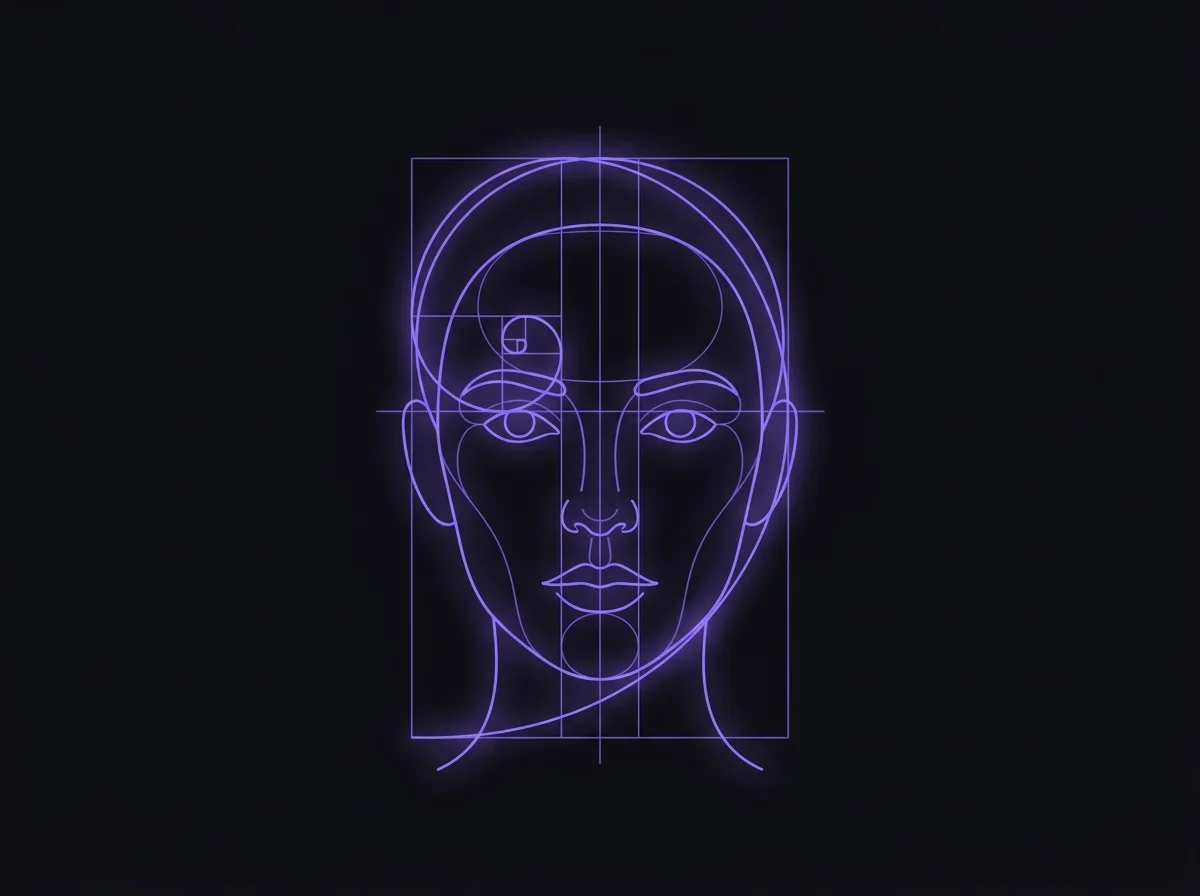
This ratio is intimately connected to the Fibonacci sequence (1, 1, 2, 3, 5, 8, 13, 21...), where each number is the sum of the two before it. As the sequence grows, consecutive terms converge on the golden ratio — 21 / 13 ≈ 1.615, 34 / 21 ≈ 1.619. Phi appears in the spiral of nautilus shells, the arrangement of sunflower seeds, the branching of trees, and the proportions of the Parthenon.
In facial aesthetics, the concept was formalized by orthodontist Stephen Marquardt, who proposed the "Marquardt mask" — a phi-based geometry overlaid on faces considered widely attractive across cultures. The theory holds that the more closely a face's proportions approach phi, the more it tends to be perceived as harmonious.
That said, it's worth holding this idea with appropriate nuance. The phi ideal is one geometric lens among many. Faces perceived as beautiful diverge significantly from the Marquardt mask. Symmetry, averageness, familiarity, expression, and cultural context all contribute to how a face reads — and none of them reduce to a single number. The phi score this tool produces is a descriptive measurement, not a measure of worth.
The facial ratios we measure
Three classical phi proportions, each comparing two facial distances to the 1.618 ideal.
Face length : width
Ideal ratio: 1.618
The vertical distance from hairline to chin compared to the horizontal width of the face at its widest point. A face whose length is ~1.618x its width follows the phi proportion.
Mouth : nose width
Ideal ratio: 1.618
The width of the mouth (corner to corner) compared to the width of the nose (nostril to nostril). A mouth roughly 1.618x the nose width is considered phi-aligned.
Lower-face thirds
Ideal ratio: 1.618
The distance from the upper lip to the chin compared to the distance from the nose tip to the upper lip. When the former is ~1.618x the latter, the lower face follows the phi proportion.
How to measure your golden ratio by hand
You can estimate your own phi ratios with a ruler on a front-facing photo printed or displayed at a fixed scale. Here is the method:
Print or display a straight-on photo
Use a passport-style photo taken straight on, with your head level and both ears visible. The more square-on the angle, the more accurate the measurements.
Measure face length and width
With a ruler, measure from the center of your hairline down to your chin (length), then the width of your face at the cheekbones (width). Divide length by width. A result near 1.618 means your face follows the phi proportion.
Measure mouth and nose
Measure the distance between the outer corners of your mouth (mouth width), then between your outer nostrils (nose width). Divide mouth by nose. Near 1.618 is phi-aligned.
Measure lower-face thirds
Measure from your nose tip down to your upper lip (A), and from your upper lip down to your chin (B). Divide B by A. A result near 1.618 means your lower face follows phi.
Golden ratio vs symmetry vs averageness
These are three distinct concepts that each describe a different dimension of facial appearance. No single one tells the full story:
Golden ratio (phi adherence)
Whether the proportional relationships between specific facial distances — length vs. width, mouth vs. nose — approach phi (1.618). This is what the current tool measures. A face can score highly on phi but be notably asymmetric, or vice versa.
Symmetry
How closely the left and right halves of your face mirror each other along the vertical midline. Symmetry and phi are independent — you can have perfectly symmetric proportions that diverge from phi, and phi-aligned proportions with noticeable left-right differences. Try our Face Symmetry Test to measure this separately.
Averageness
How close your features are to the statistical average of the population. Research consistently finds that faces closer to the average are perceived as more familiar and often more attractive — even when they are neither highly symmetric nor phi-aligned. Averageness is a third independent variable.
The Symmetry IQ app scores 8 metrics across all three dimensions — giving you the complete picture rather than one number in isolation.
Get the full 8-metric facial report
This tool measures one dimension — phi adherence. The Symmetry IQ app scores 8 facial metrics including symmetry, proportion, and balance, tracks your progress over time, and builds a personalized daily routine.

Golden ratio face calculator — FAQ
What is the golden ratio and how does it relate to faces?
The golden ratio (phi, approximately 1.618) is a mathematical proportion found throughout nature, art and architecture. In facial aesthetics, researchers have noted that several facial measurements — such as the ratio of face length to face width, or mouth width to nose width — appear closer to 1.618 in faces that are widely perceived as harmonious. The tool measures three of these proportions and scores how closely your face follows the phi ideal.
How does the golden ratio face calculator work?
Upload a front-facing photo. Our AI estimates facial landmarks and measures three phi-ratio relationships: face length to face width (ideal ~1.618), mouth width to nose width (ideal ~1.618), and the lower-face thirds proportion (lip-to-chin vs. nose-to-lip, ideal ~1.618). Each measured ratio is compared to the phi ideal of 1.618, and the closeness scores are averaged into a composite phi score from 0 to 100.
What is a good phi score?
A score of 85+ indicates strong phi adherence and is uncommon. A score of 65-84 (Harmonious) is where most balanced faces land. Below 65 (Distinctive) is the most common result and simply means your proportions follow a different geometric pattern — which is normal. The phi ideal is a centuries-old classical standard, not a definition of beauty.
Is the tool free and private?
Yes. The analysis is completely free with no account required. Your photo is sent securely for a single analysis and is not stored or used to train models. Nothing is retained after the result is returned.
Will head angle or lighting affect my result?
Yes, notably. The phi ratios we measure (especially face length-to-width) depend on a straight-on front view with level lighting. A tilted or turned head distorts width and length measurements. For the most accurate result, face the camera straight on, keep your head level, and ensure even lighting without heavy shadows on one side.
Is the golden ratio test the same as a symmetry test?
No — they measure completely different things. Symmetry measures how closely your left and right sides mirror each other. The golden ratio measures the proportional relationships between facial features (length vs. width, etc.) against the phi ideal of 1.618. A face can be highly symmetric but far from phi, or close to phi with noticeable asymmetry. You can use our Face Symmetry Test at /tools/face-symmetry-test to measure the other dimension.
Can I improve my golden ratio score?
The phi ratios we measure — face length, face width, mouth and nose width — are determined primarily by bone structure and are not meaningfully changeable through habit or routine. The golden ratio score is best thought of as descriptive information about your current proportions, not a target to optimize. The Symmetry IQ app tracks metrics that do respond to daily habits, like facial balance and tone.